
Leadership Soft Skills: How to Truly Lead, Not Just Manage
Soft skills often work invisibly, yet the results are unmistakable: projects run more smoothly, teams stay stable in a crisis, and you as a leader make decisions with a calm that others can feel. This article is about the leadership soft skills that truly matter in today's day-to-day leadership – across industries, hierarchy levels and functions.
What Leadership Soft Skills Really Involve Today
You'll get an overview of which leadership qualities define the successful leaders of tomorrow, how these competencies show up in everyday work, and how they support you in project management, in dealing with external partners, and in change processes.
That also includes a look at procoli mini as an example of how technology can complement soft skills in daily work – rather than replace them.
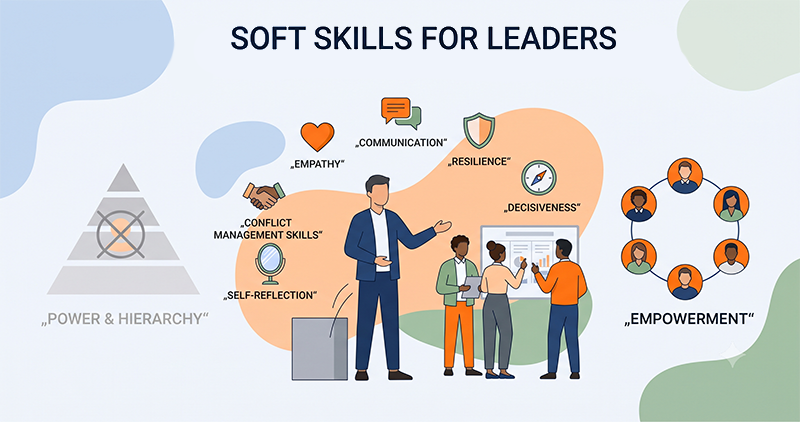
Why Leadership Soft Skills Matter More Than Expertise Today
In many organizations, the path into a leadership position still runs through technical expertise: whoever performs well technically gets promoted. And this is exactly where the emphasis shifts. Expertise remains important, but on its own it is no longer enough. Soft skills gain weight because leadership means influencing people and systems positively – not just completing and distributing tasks.
For years, Kienbaum has shown in its studies that successful leaders increasingly have an impact through emotional intelligence, communication strength and social competence (see Kienbaum – Leadership Skills for Executives - in German only). In a working world that changes quickly, and in which technologies like AI support or even partly replace many hard skills, the abilities that shape how we deal with uncertainty, diversity and change move to the foreground.
A good leader operates within tensions here: closeness and distance, clarity and empathy, pressure for results and humanity. Within this balance, soft skills enable good guidance that keeps both performance and health in view.
From Strong Specialist to Leadership Personality
Leadership doesn't mean being the smartest person in the room. Leadership means translating company goals into concrete reality while bringing people along and handing them responsibility. Ideally, a leader combines strong analytical abilities, technical strengths and a mature personality.
Many aspiring leaders experience the shift from "expert" to "manager" as a break. In everyday work, how quickly someone completes a task themselves suddenly matters less. What matters more is how well that person can motivate others, spot conflicts early and facilitate complex topics in an understandable way. This is the point where leadership separates itself from pure administration.
In many companies, leadership is still equated with power and control. But anyone who tries to steer through hierarchy loses the team's bond and trust over time. My approach as a leader is that of the "humble partner": I see myself as a partner at eye level whose main task is to clear obstacles out of the way and keep the team's back free. When people feel that I don't control them, but instead support them in doing their work excellently, an entirely new dynamic emerges. They then no longer work for a quota, but because they feel secure and valued in their role. That is the core of a modern leadership culture that goes far beyond merely distributing tasks.
Genuine leadership personalities don't use their position to emphasize hierarchy, but to carry and delegate responsibility. They keep an eye on finances, goals and risks while remaining approachable, empathetic and accessible. This mix rarely develops overnight. It grows through reflection, feedback and the deliberate development of one's own leadership competence.
Soft Skills vs. Hard Skills: Why Both Count in Everyday Leadership
In project management, in finance or in technically driven areas, the question of hard skills often comes up first. Tools, methods, systems – all of that remains important. Without this competence, a leader quickly loses credibility within the team.
At the same time, the job market clearly shows: when choosing a leader, companies pay at least as much attention to soft skills. They observe how someone deals with pressure, how feedback works, and how respectfully that person treats others. A successful career rarely comes from certificates and achievements alone – it comes from behavior that others follow voluntarily.
The most important soft skills go hand in hand with technical knowledge. Strong analytical leaders penetrate complex issues. With communication skills and teamwork, they translate insights, facilitate decisions and shape a working climate in which people contribute their strengths. This combination creates leadership that carries teams – even in a crisis.
Empathy and Emotional Intelligence: How Much Closeness Serves a Leader?
Empathy and the ability to relate form the foundation for any modern people leadership. An empathetic leader picks up on moods, recognizes non-verbal signals and reads emotional cues between the lines. Emotional intelligence doesn't mean absorbing every mood, but dealing with it consciously.
Active listening plays a central role here. Those who take time for real listening learn more about motivations, fears and wishes. This information helps with making decisions as well as with handling resistance. Many conflicts arise less from facts than from misunderstandings. Empathy reduces exactly this friction.
At the same time, distance stays important. The role of a good leader is not to be the team's best friend. A leader creates a climate of trust in which people speak openly and gladly. They value contributions, but remain capable of acting when decisions seem unpopular. This balance is what makes resilient, strong leadership.
Communication Strength and Constructive Feedback: How Words Take Effect
Communication strength shows when a leader phrases difficult messages clearly and respectfully. Conversation skills are not a one-off seminar topic here, but a daily part of the way you work. Especially in times of high strain, the manner of communication often makes the difference between motivation and withdrawal.
Strong leaders speak constructively: they describe behavior, impact and expectation instead of judging personalities. While appreciative feedback recognizes performance without slipping into empty praise, critical feedback focuses on change and development, not on blame. In this form, feedback works more positively, more quickly and more sustainably.
A proven method for this is the feedback sandwich. It consists of observation, impact and request:
| Element | What it's about | Example |
|---|---|---|
| Observation | Describe measurably what happened | "I noticed that the last meeting took longer than expected." |
| Impact | Name the consequence | "As a result, we got less feedback and things became very rushed toward the end." |
| Request | Offer a solution | "Next time, could we please cover fewer topics in one meeting?" |
The environment also plays a major role: digital collaboration, remote teams and hybrid working days demand very deliberate communication. And communication should always have a goal – if you want to work on that, read our blog on SMART goals. Clear decisions, cleanly documented information and traceable changes create orientation, especially when teams don't always work together on-site. In this environment, soft skills support not only conversations, but the entire structure.
Assertiveness and Decisiveness: Leadership With Backbone
Assertiveness is one of the classic requirements in job postings for leaders. Behind it lies the expectation that someone can make decisions even against headwind. In many situations, leadership sets clear boundaries – especially when it comes to priorities, resources or questions of values.
Assertive leadership doesn't automatically come across as harsh. It comes across as clear. A good leader listens, weighs things up and then makes a decision. They remain open to arguments, but don't postpone decisions endlessly. This creates reliability – for the team, for stakeholders and for the entire HR function.
An analytically clear view helps here: What serves the company's goals in the long term? Which risks is the team currently carrying? Which leadership culture fits that? Soft skills slow down decisions made out of ego or pure hierarchical power and steer the focus toward impact and responsibility. At the center is then no longer the question "How do I look?", but "What effect does this decision have on customers, team and company?". Leadership thus consistently orients itself toward the contribution to the bigger picture – not toward the leader's need to be right or in control.
Resilience, Self-Reflection and Conflict Skills: Stability in Times of Crisis
Leaders sometimes run into pressure, uncertainty and resistance. Resilience protects against getting stuck in stress patterns – it shows in self-regulation, clear priorities, healthy limits on availability and a reflective approach to mistakes.
A leader also develops resilience through self-critical reflection. They ask which reactions were helpful and where emotions distorted conversations. This openness has a role-model effect: team members open up more readily when the leader, too, stays willing to learn.
Conflict skills connect resilience with social competence. Recognizing and addressing conflicts early protects the working climate. Whoever can facilitate conflicts constructively strengthens both bonding and performance. Many soft skills interlock here: empathy, clarity, courage, patience.
Especially in times of crisis, a leader's strength shows not through infallibility, but through transparency. Many shy away from admitting mistakes openly – for fear of losing authority. Yet the exact opposite is true: by openly communicating my own mistakes as a "humble partner", I create psychological safety. The team notices that it's not about assigning blame, but about finding shared solutions. When the team knows that I'm not the "fault-finder", but the one who sets the frame for success and openly names my own mistakes too, willingness rises to take responsibility and address problems early. For me, that is resilience in practice: a stable working environment based on trust instead of pressure.
Developing Yourself as a Leader: How Soft Skills Grow in Everyday Work
A leader doesn't develop only in an assessment center or in theoretical preparation. Development happens above all in everyday work: in meetings, in one-on-one conversations, in crises, in quiet phases. Every situation offers opportunities to learn and to live soft skills more consciously.
A practical path looks like this, for example: regular reflection slots in your calendar, short feedback loops with trusted team members, targeted learning input through podcasts, books, mentors or seminars. More important than the amount of input is consistent application in everyday work – and the willingness to question yourself honestly.
This is exactly where our "Leadership Soft Skills – Deep Dive Reflection Guide" comes in. Instead of just handing you new concepts, it meets you in your real leadership day-to-day:
- with targeted questions on collaboration, empathy, delegating responsibility, resilience, self-reflection and conflict skills
- phrased so that you don't stay on the surface, but recognize your recurring patterns
- as a printable PDF that you can work through by hand at your own pace – for yourself alone or as a basis in coaching
If you want your soft skills to be more than just "nice to have" and to genuinely shape your daily leadership, deliberately set aside 30–60 minutes with this guide and use it as the starting point for your personal development plan.
Networking also plays a role. Exchanging ideas with other leadership personalities at a similar hierarchy level provides perspective and relief. Experiences with people leadership, change processes or large projects feel more tangible when others share how they solved things – and that's exactly when your honest self-reflection in the guide turns into a conversation at eye level: about leadership that is more than administration.
Soft Skills in Job Postings and the Job Market: What Candidates and Companies Look For
The job market shows a clear trend: alongside expertise, job postings increasingly emphasize topics like teamwork, communication strength and empathy. Companies look for leaders who possess genuine leadership qualities, not just technical knowledge.
In HR, observing behavior gains great importance. In interviews, exercises and trial tasks, HR and departments watch for soft-skill signals: How does someone act under pressure? How does the person react to criticism? How do they approach others? All of that feeds into decisions for or against a leadership position.
For aspiring leaders, this means: the right soft skills act like a second profile next to the résumé. They often decide whether someone is entrusted with responsibility – and how sustainably that decision plays out.
A Checklist for a Leader's Soft Skills – and How Technology Supports in the Background
To close, a checklist that makes soft skills tangible in everyday work. It serves as a mirror, not as an evaluation:
- In everyday work, I experience myself as empathetic and consciously pick up on emotional signals, for example.
- I know my communication strengths and weaknesses in conversations with individuals and in groups.
- I handle successes appreciatively and address performance concretely.
- I give criticism constructively and stay with behavior, not with people.
- I use my assertiveness to draw clear lines without losing respect.
- I use my resilience to make decisions calmly even in moments of crisis.
- I experience myself as a team player, give space and encourage participation, for example.
- I take responsibility for my leadership culture and the working climate, not just for numbers.
- I see soft skills as a fundamental building block of my daily leadership competence, not as a "nice-to-have".
Soft skills unfold their impact particularly strongly where structures support them. In complex projects with many people involved – internal and external – a leader needs robust processes alongside empathy and clarity. This is where tools like procoli mini make sense: external and internal partners jump straight into tasks via link-based collaboration, receive automated notifications, participate in an interactive web view, and share files by upload and download – without login barriers. The result is a transparent flow of information that relieves project management, communication and collaboration.
In the long term, procoli aims to integrate various management tools and to use automation so that statuses, milestones and decisions remain centrally visible – all to relieve you, so you can focus on leading instead of administering. Because this technical foundation helps leaders live soft skills in everyday work: fewer status inquiries, more room for conversation, coaching and real leadership tasks. If you want to try that out, sign up for the procoli waiting list and secure early access.
Key Points to Remember
- Soft skills complement expertise and determine how effectively a leader acts in everyday work.
- Empathy, emotional intelligence and active listening strengthen trust and collaboration.
- Communication skills, constructive feedback and clear decisions shape good leadership.
- Resilience, self-reflection and conflict skills keep leaders stable in difficult phases.
- Leadership qualities develop through experience, reflection and exchange – not just through seminars.
- Companies and candidates pay increasing attention in the job market to social competence and a genuine leadership culture.
- Technologies like procoli relieve structures and create transparency, so you gain time to focus on leading.
Q&A
What are the most important leadership soft skills?
The most important leadership soft skills range from empathy, communication strength and teamwork through resilience to assertiveness. A leader additionally benefits from analytical strength, emotional intelligence and the ability to recognize conflicts early and address them constructively. Expertise remains important, but in everyday work soft skills often decide more strongly whether a leader builds trust and brings people along.
Why do soft skills play such a big role for a good leader?
A good leader leads people, not just tasks. Soft skills enable a climate of trust in which employees speak openly, take responsibility and contribute their strengths. Good leadership combines technically sound decisions with an appreciative manner, clear language and an empathetic attitude. Without these abilities, strong hard skills often come across as cold or distant.
How do soft skills and hard skills differ for leaders?
Hard skills comprise measurable expertise, technical knowledge, numerical understanding and methodological competence. Soft skills describe the way a leader deals with people: listening, delegating, motivating, appreciating, facilitating conversations and handling resistance. Together they add up to leadership competence: hard skills create the basis, soft skills bring the impact.
What role does emotional intelligence play in everyday leadership?
Emotional intelligence helps leaders perceive, understand and respond appropriately to their own emotions and the feelings of others. In everyday leadership, it helps to recognize emotional signals early, assess situations better and stay appreciative in conversations. In its leadership analyses, Kienbaum explicitly emphasizes the importance of emotional intelligence as a central factor of effective leadership.
How do aspiring leaders best develop their soft skills?
Aspiring leaders develop soft skills above all in everyday work. Reflection after important conversations, honest feedback from colleagues, targeted development through coaching or seminars, and the courage to try new things all interlock here. A leader benefits from regularly checking how empathetic they come across, how clearly their communication lands, and how stable they stay in change processes.
Which soft skills appear especially often in job postings for leaders?
In job postings for leaders, alongside technical expertise you almost always find terms like communication skills, teamwork, empathy, pronounced leadership competence and high social competence. Companies expect a leader not only to work in a technically strong way, but also to approach people, resolve conflicts and shape a good working climate.
What defines a good leader in handling conflicts?
A good leader stays calm, empathetic and clear in a conflict. They address tensions instead of ignoring them, listen actively and focus on solutions. They use their soft skills to recognize conflicts early, facilitate them constructively and reach workable agreements for everyone involved. In this way, they help the team learn from conflicts and strengthen collaboration.
Which soft skills help leaders in a crisis?
In a crisis, resilience, mental clarity and the ability to make decisions without any certainty are what carry you most. Resilient leaders keep sight of priorities, communicate openly about challenges and stay approachable for their team. They pay attention to their own strain and protect the team from chronic stress by staying focused and limiting overload.
How does technology support a leader's soft skills?
Soft skills remain human, but technology supports them in the background. procoli mini makes people leadership and project management easier because information, tasks and decisions don't get lost in email chains. External partners jump straight into tasks via links, see an interactive web view, receive automated notifications and collaborate transparently. That strengthens communication strength, appreciative collaboration and a climate of trust – because when you spend less time administering, you have more time to lead.
Why is a deliberate focus on soft skills worthwhile for a successful career as a leader?
A successful career as a leader rarely comes from technically strong performance alone. Anyone who leads over the long term needs mature soft skills alongside expertise: empathy, clarity, courage, the ability to reflect. This mix creates trust with teams, with superiors and with customers. It lays the foundation for people to follow a leader – not because they have to, but because they want to.